
Writing with Disability: Turning a traumatic injury into a self-publishing journey
by K.K. Salathe
Trigger warnings: Bipolar Mania, Depression, Addiction, Injury
-
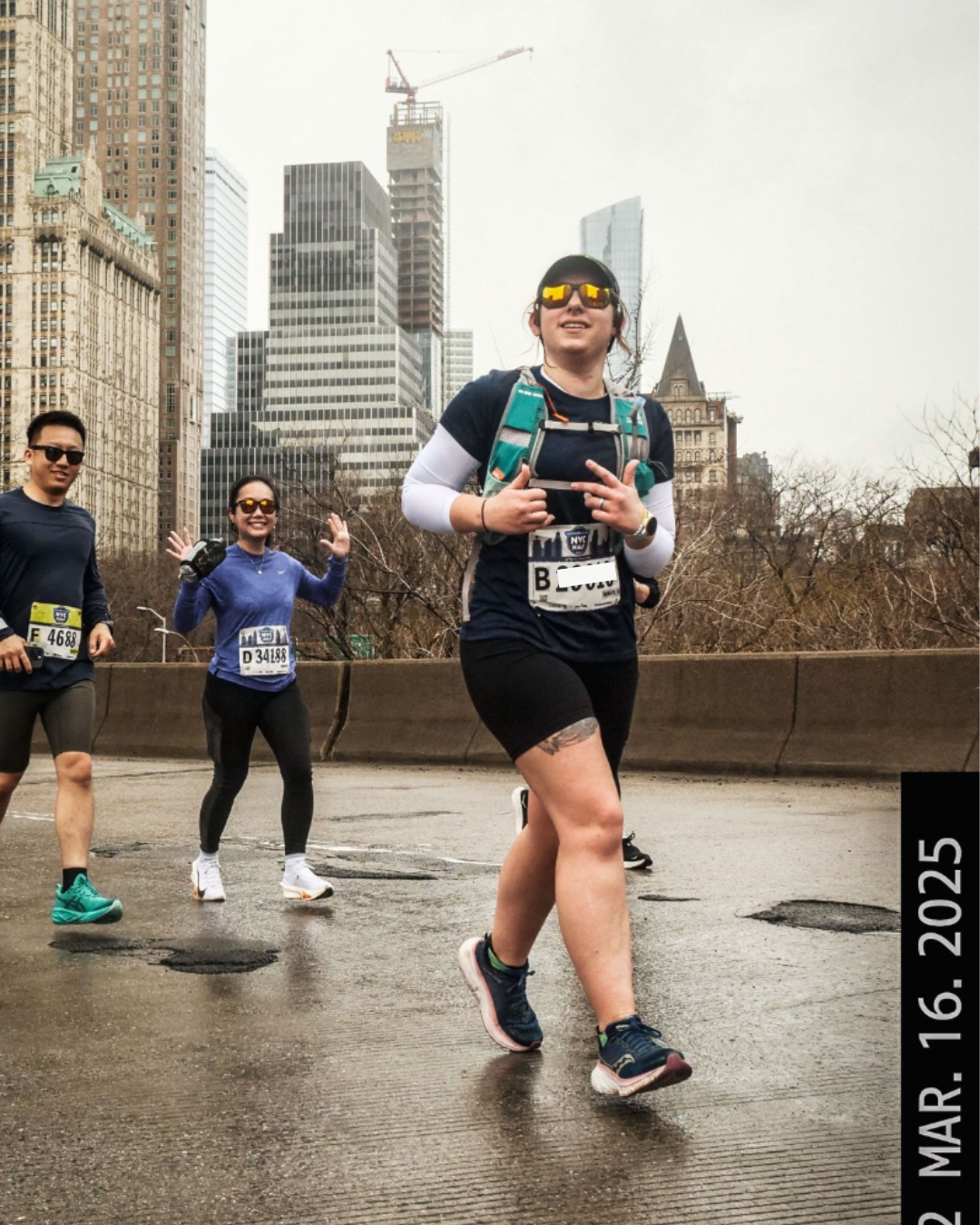
NYC. March 16th, 2025.
It was an overcast day, with fog sticking to the streets and a slight chill to the air. This was the type of weather you hope for on race day, perfect for running.
The city held an energy that was palpable, electrifying. The kind that surged through your veins, lighting up something inside that screamed “I can do this.”
Nearly 30,000 runners. Even more spectators. Hundred-dollar shoes. Perfectly curated playlists. Months spent training. A collective coming together, energized and excited. Because a half marathon isn’t a performance–it’s a celebration.
My goal was simple. Two hours, thirty-five minutes. About a 12’00”/mile average pace. Keep it steady at first, then ramp up at the end after energy has been conserved. That may seem slow to some, but I had come back from broken to be able to achieve this.
I could do this. I was going to do this. I’d trained to do this.
Corral B. Wave 5. Runners, get ready.
Let's go.
Mile 1: 12’23”
Mile 2: 12’54”
Mile 3: 11’31”
I can do this.
Mile 4: 13’03”
Mile 5: 12’51”
My hip is starting to hurt.
It’s okay.
I’ll be okay.
Mile 6: 12’28”
Something feels off.
Mile 7: 13’50”
Halfway there.
Pull it together.
Mile 8: 14’17”
Something is wrong.
Keep pushing.
Mile 9: 16’29”
Don't stop.
Mile 10: 17’42”
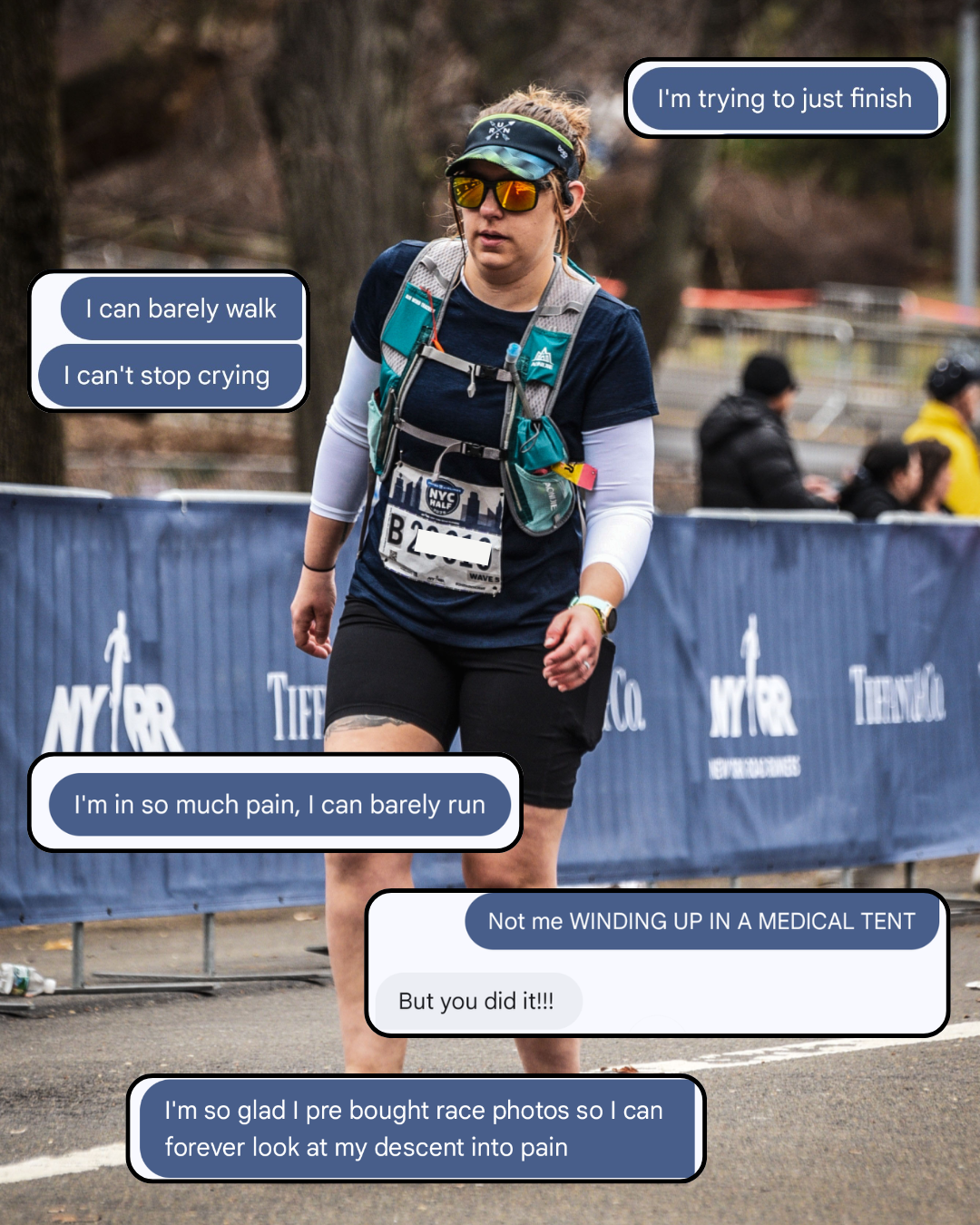
“I’m in so much pain, I can barely run.”
Keep walking.
Keep moving.
Mile 11: 16’21”
Something is really wrong.
But I have to finish.
I worked too hard for this.
Mile 12: 19’14”
“I can barely walk. I can’t stop crying.”
“Focus on something else. Talk to yourself. Envision the finish line.”
I can’t do this.
I have to do this.
Mile 13: 22’00”
It’s not okay.
I'm not okay.
Mile 13.1: 34’00”
Final time: 3 hours, 27 minutes, 40 seconds.
It’s your fault.
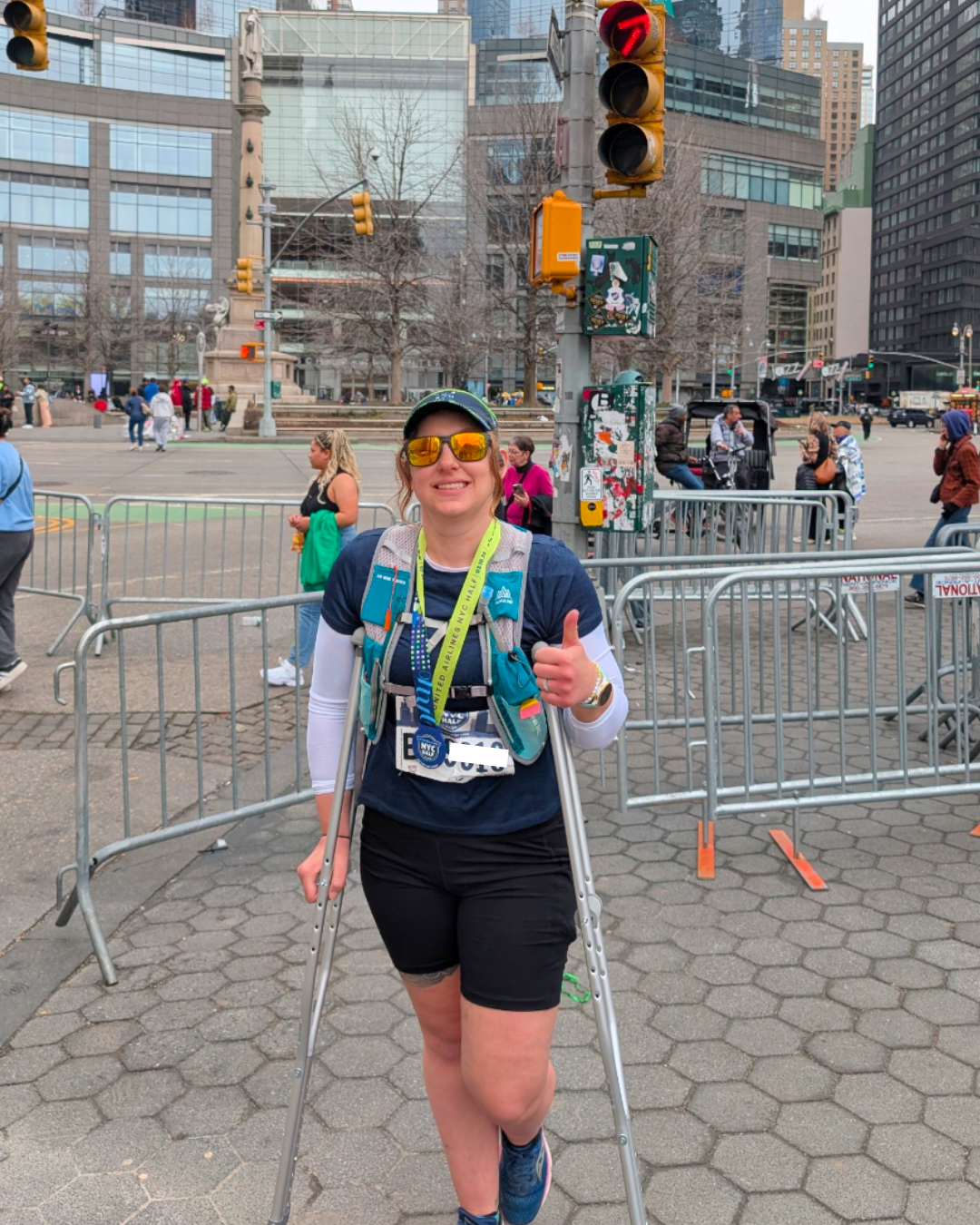
The medal didn’t feel like a win. My left hip was struggling to hold me upright, nearly collapsing with every step as I dragged myself into the medical tent at the finish line. I was delusional and thought it’d be a quick fix–some lidocaine spray and I’d be on my way to go celebrate this monumental achievement at La Pecora Bianca for some housemade pasta. I’m a tough girl. I can suck up the pain for the night and get it figured out once I’m back home. But every movement felt like fire exploding through my hip and thigh. Barely holding it together and biting back tears, I let them sit me down on some makeshift medical bed in the tent. They handed me an ice pack, water, and some crackers, and while snacking away, I snapped a picture of me with my medal to send to my sister.
“Not me winding up in a medical tent.”
“But you did it!”
I finished one of the largest half marathons in the entire world. I did it. But…what did it cost me?
It’s your fault.
Unbeknownst to me, that was the last time I would walk without an assistive device for over 10 months. I was physically unable to get myself up from that medical bed, and I couldn’t stand on my own.
It’s your fault.
I knew the NYC Half Marathon was going to be a pivotal moment in my life, but not like this. The medical staff handed me a pair of crutches, and I began the half-mile trek to the exit gate. Someone helped me get a picture in front of the NYC Half banner, then flagged down medical staff to force them to get a wheelchair. I think about the kindness of that stranger a lot.
It’s your fault.
At the hotel room, with silence creeping in to expose every crack the day had initiated in me–I broke down. I cried. And cried. And cried. Sweaty, exhausted, and in a blinding amount of pain. Unable to freeze out the gut-wrenching disappointment that something I had worked so hard to achieve went catastrophically wrong.
It’s your fault.
I disassociated. Cracked a joke on social media with a picture from the finish line–“But how many people get a free pair of crutches with their half-marathon medal?” A cover for how terrified and devastated I really was, expertly hiding that I may have ruined my life.
It's your fault.
Once back home in Colorado, I chucked the medal into a different room. A memento that runners usually look at with pride, I viewed with utter abhorrence.
And the race photos that came in shortly after? There was one, just one, that I liked. The rest encompassed the struggle, the smile leaving my face, and something like fear replacing it. It showed a shell of the woman who started the race.
“I’m so glad I pre-bought race photos so I can forever look at my descent into pain.”
It’s your fault.
A week later, I found out what happened. Broken femur. Multiple hip labrum tears. It was a miracle I crossed the finish line without displacing the fracture. Surgery was scheduled the following week, and I left the hospital with multiple screws and a plate in my leg.
Upcoming races cancelled. Physical therapy scheduled. I tried to shift my mindset from being an athlete to recovery-focused. Except I didn’t heal. The weeks went by, and with each appointment, the surgeon added to the lead sinking in my stomach. “You're not healing the way we'd expect."
It’s your fault.
My bipolar took the reins, and I fell into the deepest manic-depressive episode I’ve ever experienced. I couldn’t get out, the pit just kept getting deeper. Staying active was how I kept the demons at bay, and I’d lost that in a three-hour window. Three hours. That’s all it took to completely destroy the life I knew, the woman I was. And as each day passed, I was growing more unsure if I’d ever be able to return to it. I began to lose hope. I kept pushing, kept trying. But I knew there wasn’t an end in sight. At one point, I registered there would be a strong likelihood that I’d permanently need a cane.
It’s your fault.
I don’t remember much of the year between March and October. I knew it dragged on, each day a battle. Pain, tears, fear, and struggling just to survive every passing hour. I couldn’t understand how I’d ended up in this situation–I had trained well for the race, I was smart about my schedule. Ate well and rested. When it came to recovery rehab, it felt like no matter what I did, it wasn’t getting better.
It’s your fault.
Everyone kept telling me I was so strong. But I wasn’t–I just didn’t have a choice but to keep pushing forward. The worst part? Everyone knew I was struggling. Everyone knew I was drowning, gasping for air during the split-second I broke the surface before being yanked under the relentless waves in a never-ending storm. And yet, the life raft never moved closer. Texts went unanswered. Calls straight to voicemail. People who cared when I was training and racing were suddenly silent.
I felt alone. I was alone.
It’s your fault.
I started taking videos of my progress from the very first week, with the goal to create a “comeback” video when I finally ran another half marathon. A goal that I’ll likely never be able to achieve again. While it did help to be able to look back and see at least the small points of progress, I also captured the light leaving my eyes. My heart shattering. Hopelessness. Emotional exhaustion. Just…nothingness. Manic depression slowly chipping away at me and my identity.
It’s your fault.
Then I finally hit the low point. I was tempted to break sobriety. I had stopped drinking a year and a half prior, a necessity after a months-long manic episode ultimately led to a bipolar diagnosis back in 2023. But I was sick of feeling both everything and nothing at once, my chest caving in yet being ripped apart. It felt like I was standing on the edge of a cliff, the wind holding me upright and the ocean crashing below me. I wanted to feel that fall, that rush of air in my lungs that would make me feel alive for a split second.
And I wanted the quiet. For the noise in my head to finally disappear and allow me to let out the breath I had been holding for months on end.
When the realization hit, I was suddenly back in that hole. In the dark, crying, breaking, collapsing–that was the point I was forced to come to terms with how bad I’d fallen.
With frantic energy, I clawed at the walls of the pit I was in, terrified I’d never see the sun again.
It’s your fault.
One early summer day, I opened up my computer, and read through an old story of mine from nearly a decade ago that had less than 5,000 words. It was a wolf shifter romance with a loose plot about questioning fate. Then I just…started writing. I wrote, and wrote, and wrote. I poured everything I felt into the pages. The trauma, things that had been said to me, fears about my future and unknown outcomes, the journey of figuring out who I am in the world after feeling like I’d lost a piece of myself. I even unintentionally wrote about bipolar mania and what it feels like being at war with yourself, with noise bleeding in constantly.
I dove into this fantasy world I created, utilizing mania for late nights of productivity. I escaped with these characters, these individuals with big dreams and goals for their lives that I could help them achieve. I could sympathize with the ones who wanted something so badly but they could never have. I cried for the character who felt broken. The one who put up walls. The one who shut down and ran away. I shattered for the ones who felt like they lost who they were, their identity.
For the girl with nightmares that wouldn’t let her sleep.
It’s your fault.
By the middle of summer, I had 130,000 words written. A 480-page novel. Then I took the leap that every first-time author is scared of–I shared the manuscript with a friend. They loved it, praised it. Looking back, I think that was the only bit of pride and legitimate joy I felt the entire year. Because all of the trauma and everything I had endured…it helped create something that people wanted to read, that they enjoyed reading.
I made the decision right then. I was going to self-publish. A few weeks later, I found a local fantasy writer group, and some of those individuals would not only become my friends, but my fellow board members for Celerity Collective.
Then September came. Still no progress with recovery, and I was even regressing with no hope in sight. More surgeon consults, more diagnostic tests. Then finally, an answer to why I wasn’t healing–there were complications from the first surgery, along with the secondary injury that needed to be fixed.
It’s your fault.
A second surgery was scheduled for October. The surgeon said they couldn’t promise it would help, but we had to try. Until then, I kept writing. I created a deeper world for my characters, ultimately landing on a 5-book series. I gave my manuscript to even more people.
Surgery day came and went. But this time–with a support system I needed, and manuscripts to fall into. I started writing other stories, fueling them with whatever I was feeling at the time. It was a healthy outlet for all of the pent-up and complex emotions shaking my cage.
In 2025, I wrote over 350,000 words.
The healing finally started; physically, emotionally, and mentally. Then, after ten months, two surgeries, and over 45 physical therapy sessions, I walked with a cane for the last time. It’s still sitting in a corner near the front door after nearly two months, because there’s something in the back of my mind telling me that it’s all too good to be true, that I can’t put it away just yet.
Even with all the progress, I knew underneath it all was a disability without a name. Months of fighting for answers, and I finally had it. Osteoporotic at 36. Confirmation that my running days are done. Not the explanation I wanted but still…an answer. Now I’ve begun the hunt for the “why.”
It’s… not your fault.
It’s not my fault. Something catastrophic and traumatic happened to me, that I couldn’t possibly know about or prepare for. It’s taken a lot of healing to shake those words from my head, the ones that clung to me like an affliction of its own.
Life has a lot of unknowns right now. My athlete days are over, or maybe they’ll just look a bit different. Softer, adjusted, more collaborative and less combative with chronic illness.
But at least one thing is certain–I’m an author now.
Honestly, I think writing saved me. I think Countdown to the Chosen Wolf and The Countdown Series rescued me from the depths of my own manic spiral and pulled me out, word by word.
Some days, I look back at who I was those first few months of 2025. Truthfully, I miss her. She was a different woman entirely. Different goals. Different outlook on life. I miss that I can’t go back to that version of myself ever again.
But I love who I’m becoming.
To the ones battling a disability daily, or maybe just temporarily–start writing and escape into a fantasy world of your own creation. Find yourself in the words.
Disability doesn’t diminish us as authors.
It makes us stronger.
-
K.K. Salathe’s debut novel, Countdown to the Chosen Wolf, will be indie-published in summer/fall 2026. It is Book 1 of a planned 5-book series.
